
Tuesday, February 3, 2015


Plans for 137 - initial wish list
Plans for 137 Erie
Overall feelings
In keeping with 1940/50s home
Cottage, Warm, Cozy
Same footprint of house
Rich colours
Lots of windows
Dining area booth
Counter to ceiling window in kitchen with no upper cupboards
Dining room
Open to kitchen
Entry door moved to south
Wood and glass doors opening onto deck
Dining area with L-shaped built in bench
Similar footprint
Textures
Real Wood floor
Painted wood ceiling, white
Bathroom
Keep tub
White glass tiles to surround
Pocket door for entry
Pocket door closes linen closet when bathroom door is open
Kitchen
Gas stove
Vent to outside with hood
No upper cupboard
Pantry
Basement
Replace stairs
Windows
Replace throughout

Saturday, June 7, 2014

Sunday, March 11, 2012
With yellow, comes greens
 It has been a glorious sunny day. My glasses steamed-up when I stepped into the hoop-house and condensation fell like rain when I bumped one of the hoops.
This time last year we had snow and it certainly wasn't 12 degrees, and today we opened all the windows and the door. It was as if the house exhaled; I could smell the moist earth and warming greens from meters away.

I find it amazing that in the moderated climate of the hoop house, a bitter cold winter like the one last year yields very much the same as a mild winter, like the one we are just stepping out of. A testament to the efficiency of the hoop house design and to the adaptability of plants.
Last fall I had envisioned a majestic crop of kale seeing us through the bitter cold months, fortifying our pastas and soups.

The seeds I sowed in late September certainly showed promise; they sprouted quickly and grew sturdily. Sadly, as they approached 3 inches tall, standing proudly in their little soldier rows, I realized I had grabbed the wrong seed packet, and planted tomatoes. Aaaargh!

Even though it was October, I hastily re-sowed two types of kale and crossed my fingers. At some point, I had lost track of them and they were overcome with weeds and the space-hungry spinach.
Today, clearing out the chickweed, I found them, small but waiting patiently to spring to life.
Today, my trug was brimming with greens, onions, spinach, herbs ... thank you hoopie.
What a difference a year makes ...
... and much has happened in this one year.


We remain determined to lesson our reliance on fossil fuels and tread ever more gently on the earth. As well, I can't deny that I am comforted by the idea of being able to heat our home, boil water and cook a meal in the event of a power outage.
Last fall we had a high-efficiency wood stove installed in the basement to supplement our gas furnace. Nine face cords of wood
were delivered in October from Orchard Hill Farm and an additional two from another source in February.
We spent much of the winter chopping, carting wood from garage to basement, and stoking, stoking, stoking. First thing in the morning, before the dog is walked or the coffee is made, we start the fire. And like us, it gets fed about three times a day.
The temperature of the house has ranged from cool (I'll often hear the furnace start-up early in the morning, triggered by a temperature drop to 16 degrees) to warmer than I'd prefer (21 degrees in the living room which it located closely above the stove). Burning only clean, cured wood, at the proper temperature, keeps the amount of smoke being exhausted to a minimum, though even when smoldering I can't smell it in the house. It's fantastic when, outside in the cold of the winter, I inhale the comforting, warming, familiar smell of burning wood.
Robin devised an ingenious system of managing our hot, morning ashes.
The embers are removed from the stove into a metal bucket with a lid. This bucket is taken outside and placed in a metal garbage can to cool. The next morning the still-warm ashes are dumped from the bucket into a second metal garbage can
. This can will continue to fill until we need to take it to someones farm or garden to dump. We have emptied it four times so far and will have one more trip to make.
I'll do a more thorough analysis in a couple of months, but so far it would appear our gas consumption was roughly halved through our efforts. We also have used our clothes dryer only two or three times, preferring instead to hang our clothes to dry by the fire.
Preparations are already underway for next winter; 6 face cords of wood have been delivered and are now stacked, ready to cure over the summer.
$5000.00 for the wood stove, which was a display model with all the fixin's, installed and ready to go
$600 for 9 face cords, $100 for two additional = $700 for fuel.
Wednesday, March 30, 2011
Saint Patty Greens

After weeks of dormancy, a few days of blazing sunshine in March gave us the confidence to give the hoop house a breather and check out what was growing inside.

We had pretty much left everything alone for January and February as we hunkered down through bitter cold, dull days. Snow had completely covered the house a few times and I could see ice flaking off the inside was I removed snow (sometimes 5 inches) off the taunt plastic.
If I had been blind-folded when I entered the hoop house on St. Patrick's Day , I would have experienced a flash-back of a visit to the tropical forest pavilion at the Toronto Metro Zoo (though devoid of primates and tourists).

The space was warm, and the air was thick with the smell of humid, moist earth, and wet wood. Here and there, water was dripping from the curved ceiling.
 The carrots, spinach, kale and tender greens had survived the dark days of winter, and maybe even grew a bit. Unfortunately, so did the chickweed which must have snuck into the garden along with some soil or manure.
Actually, the chickweed had thrived and was overgrowing everything else.
Who knew I'd be weeding the garden in
 March! In some areas I was removing clumps at a time, but in others I had to gently remove the tendrils from around the greens. Throughout I had to be careful not to uproot the yummies when I removed the ickies.
Of course, I did end up pulling up a lot of the tender shoots that I was attempting to rescue, but the earth was so soft I simply made a hole with my finger and replaced the root.
When I checked on the re-plants a couple of weeks later, they were growing happily, now that their strangling housemates had been evicted.

As I weeded the greens and thinned the carrots, I noticed the soil was warm and loose, having never been trampled by two or four-legged creatures all winter. Worms rose to the surface, rising cobra-like as if to to catch a bit of warmth or fragrance, before slithering off.
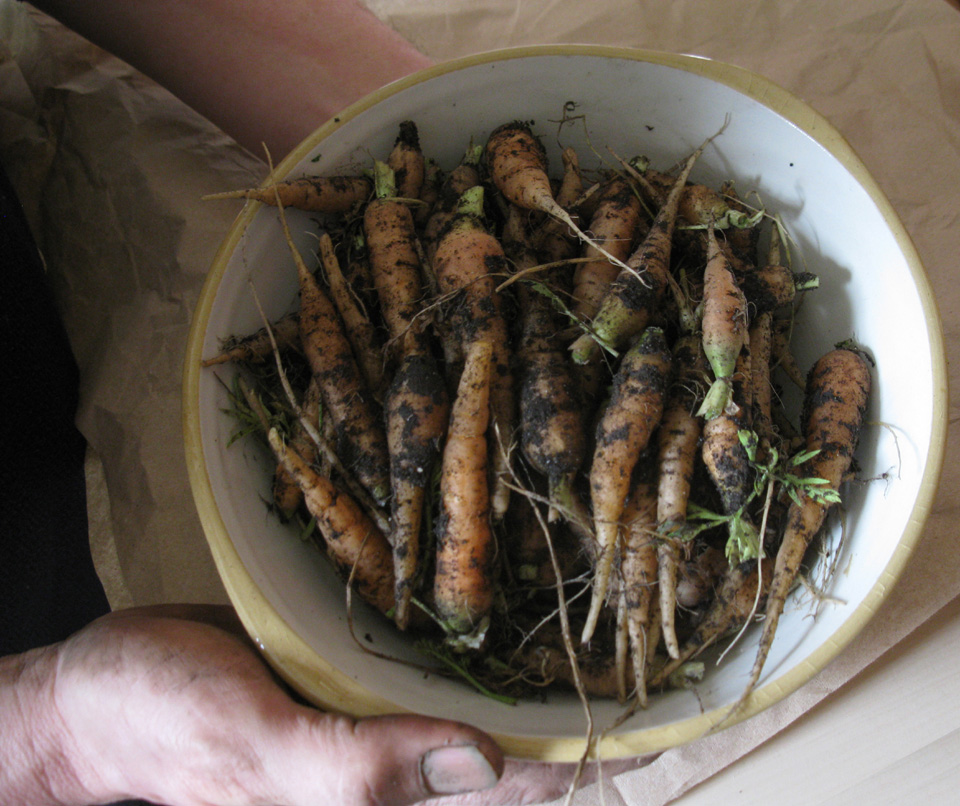
A few dozen baby carrots were pulled as we thinned the crop. Tender and flavourful, our first crop of 2011 was crisp and candy-sweet.
Wednesday, September 8, 2010
 The start of September found us, not relaxing in anticipation of a colourful fall, but racing the clock trying to get the hoop house structure done in time for planting.
Some of the slower growing plants, such as Kale, were sown indoors and had already begun sprouting in their little pods, ready to be transplanted to the ground. The carrots would need to be sown a.s.a.p. and the beets soon after.
 With the tarmac cut and removed, the hoops secured to each other and to the newly erected ground borders, we were ready to plan the end walls. Working with the curved structure was tricky enough, but we also had to be cognitive of the fact we would need to wrap the entire structure in plastic yet retain the ability to open the sides in the summer for North / South air flow.
 The ends were framed in, like with any wall construction, using 2 x 4s and allowing for a door and one window at the West end, and two windows at the East.
While securing the central pole to the end walls we were reminded the new structure afforded us much more height (from a peak height of 7' in the previous structure to 8.5' now)
 as we had to utilize a ladder for much of the work. We also had to take into consideration we will be wrapping the ends with plastic and therefore had to allow for the plastic to fold over the end hoop.

Over the span of one weekend, both end walls were constructed
with thanks to help from Lisa H, Lisa M, Alicia, Jane and Laura.
 Lisa has donated, apart from hours of her time, and the design for the new ends, three beautiful vintage windows, which will be re-purposed for this house as air vents.
The internal foot path has been curved into a "U" which now divides the garden into reachable plots; North, centre, South.
 The new path structure was leveled and buried prior to the fresh topsoil being applied to the expanded portion of the garden.
 We've cleverly solved the problem of whether the windows should swing inwards or outwards and how they will be propped open to offer the least opportunity for one to smack one's head. Instead of either option, the windows will be hinged at the bottom allowing them to swing completely open and down, to hang flush with the wall, supported by their hinges. They will be installed in the spring.
 We've also designed a way to keep unwanted visitors at bay. A three foot high band of chicken wire has been installed at the base of each side wall. The final sheet of plastic which in one piece will arc over the entire structure, will be installed over top of the wire. In the spring we will simply detach the plastic from the bottom, rolling the plastic up three feet to reveal the wire and allow for ventilation.
With the end walls up, the door and chicken wire installed, we were able to get the carrots in the ground (and covered with landscaping cloth for extra warmth). The next task will be to raise the roof; to cover the top and sides with one huge sheet of plastic. At this point, we likely have 4 to 6 weeks before the first frost.
Subscribe to:
Posts (Atom)


