Showing posts with label hoop house. Show all posts

Sunday, March 11, 2012

With yellow, comes greens

It has been a glorious sunny day. My glasses steamed-up when I stepped into the hoop-house and condensation fell like rain when I bumped one of the hoops.

This time last year we had snow and it certainly wasn't 12 degrees, and today we opened all the windows and the door. It was as if the house exhaled; I could smell the moist earth and warming greens from meters away.

I find it amazing that in the moderated climate of the hoop house, a bitter cold winter like the one last year yields very much the same as a mild winter, like the one we are just stepping out of. A testament to the efficiency of the hoop house design and to the adaptability of plants.

Last fall I had envisioned a majestic crop of kale seeing us through the bitter cold months, fortifying our pastas and soups.

The seeds I sowed in late September certainly showed promise; they sprouted quickly and grew sturdily. Sadly, as they approached 3 inches tall, standing proudly in their little soldier rows, I realized I had grabbed the wrong seed packet, and planted tomatoes. Aaaargh!

Even though it was October, I hastily re-sowed two types of kale and crossed my fingers. At some point, I had lost track of them and they were overcome with weeds and the space-hungry spinach.

Today, clearing out the chickweed, I found them, small but waiting patiently to spring to life.

Today, my trug was brimming with greens, onions, spinach, herbs ... thank you hoopie.

Wednesday, March 30, 2011

Saint Patty Greens


After weeks of dormancy, a few days of blazing sunshine in March gave us the confidence to give the hoop house a breather and check out what was growing inside.


We had pretty much left everything alone for January and February as we hunkered down through bitter cold, dull days. Snow had completely covered the house a few times and I could see ice flaking off the inside was I removed snow (sometimes 5 inches) off the taunt plastic.

If I had been blind-folded when I entered the hoop house on St. Patrick's Day , I would have experienced a flash-back of a visit to the tropical forest pavilion at the Toronto Metro Zoo (though devoid of primates and tourists).


The space was warm, and the air was thick with the smell of humid, moist earth, and wet wood. Here and there, water was dripping from the curved ceiling.

The carrots, spinach, kale and tender greens had survived the dark days of winter, and maybe even grew a bit. Unfortunately, so did the chickweed which must have snuck into the garden along with some soil or manure.

Actually, the chickweed had thrived and was overgrowing everything else.

Who knew I'd be weeding the garden in
March! In some areas I was removing clumps at a time, but in others I had to gently remove the tendrils from around the greens. Throughout I had to be careful not to uproot the yummies when I removed the ickies.

Of course, I did end up pulling up a lot of the tender shoots that I was attempting to rescue, but the earth was so soft I simply made a hole with my finger and replaced the root.

When I checked on the re-plants a couple of weeks later, they were growing happily, now that their strangling housemates had been evicted.


As I weeded the greens and thinned the carrots, I noticed the soil was warm and loose, having never been trampled by two or four-legged creatures all winter. Worms rose to the surface, rising cobra-like as if to to catch a bit of warmth or fragrance, before slithering off.


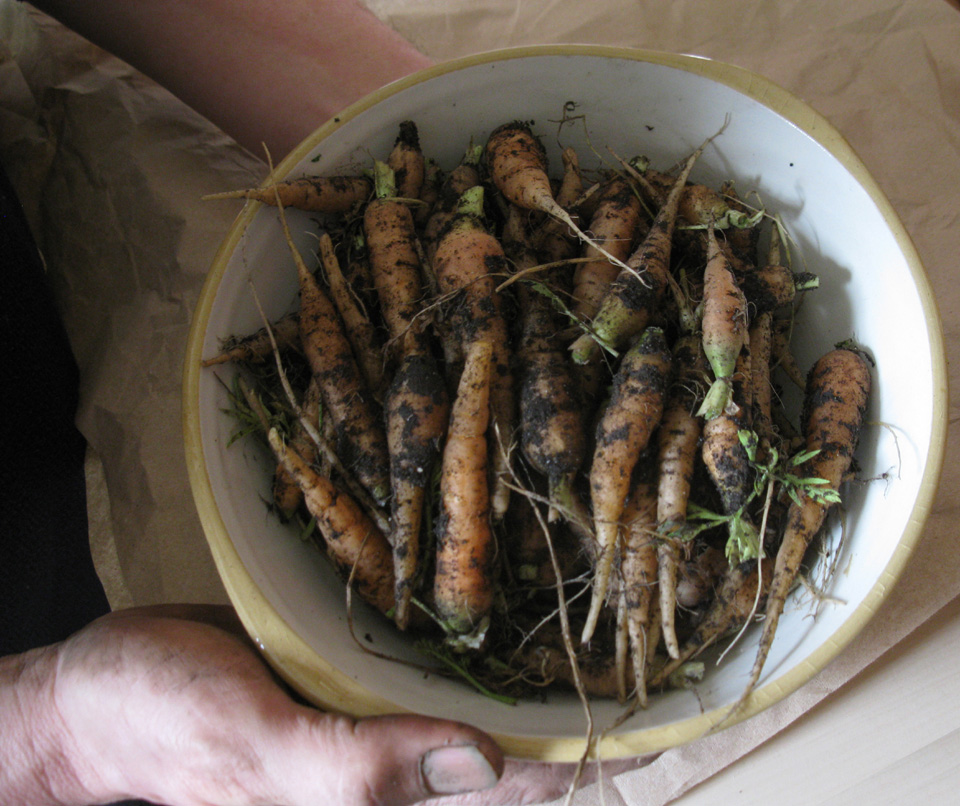
A few dozen baby carrots were pulled as we thinned the crop. Tender and flavourful, our first crop of 2011 was crisp and candy-sweet.

Wednesday, September 8, 2010

The start of September found us, not relaxing in anticipation of a colourful fall, but racing the clock trying to get the hoop house structure done in time for planting.

Some of the slower growing plants, such as Kale, were sown indoors and had already begun sprouting in their little pods, ready to be transplanted to the ground. The carrots would need to be sown a.s.a.p. and the beets soon after.

With the tarmac cut and removed, the hoops secured to each other and to the newly erected ground borders, we were ready to plan the end walls. Working with the curved structure was tricky enough, but we also had to be cognitive of the fact we would need to wrap the entire structure in plastic yet retain the ability to open the sides in the summer for North / South air flow.

The ends were framed in, like with any wall construction, using 2 x 4s and allowing for a door and one window at the West end, and two windows at the East.

While securing the central pole to the end walls we were reminded the new structure afforded us much more height (from a peak height of 7' in the previous structure to 8.5' now) as we had to utilize a ladder for much of the work. We also had to take into consideration we will be wrapping the ends with plastic and therefore had to allow for the plastic to fold over the end hoop.

Over the span of one weekend, both end walls were constructed
with thanks to help from Lisa H, Lisa M, Alicia, Jane and Laura.

Lisa has donated, apart from hours of her time, and the design for the new ends, three beautiful vintage windows, which will be re-purposed for this house as air vents.

The internal foot path has been curved into a "U" which now divides the garden into reachable plots; North, centre, South. The new path structure was leveled and buried prior to the fresh topsoil being applied to the expanded portion of the garden.

We've cleverly solved the problem of whether the windows should swing inwards or outwards and how they will be propped open to offer the least opportunity for one to smack one's head. Instead of either option, the windows will be hinged at the bottom allowing them to swing completely open and down, to hang flush with the wall, supported by their hinges. They will be installed in the spring.


We've also designed a way to keep unwanted visitors at bay. A three foot high band of chicken wire has been installed at the base of each side wall. The final sheet of plastic which in one piece will arc over the entire structure, will be installed over top of the wire. In the spring we will simply detach the plastic from the bottom, rolling the plastic up three feet to reveal the wire and allow for ventilation.


With the end walls up, the door and chicken wire installed, we were able to get the carrots in the ground (and covered with landscaping cloth for extra warmth). The next task will be to raise the roof; to cover the top and sides with one huge sheet of plastic. At this point, we likely have 4 to 6 weeks before the first frost.

Sunday, August 15, 2010

Hoop House 2010, continued

And so, our brave little 12 foot wide, 20 feet long PVC tubing structure had served us well for two winters, but was not strong or adaptable enough to handle both hot and cold months.

We needed something Bionic; bigger, stronger and able to allow generous air flow.

Prompted by a heads-up from Lisa M about an ad in our local Buy and Sell, we contacted the owners of a nursery in our region who were downsizing and selling off their extra hoops. Made of metal, taller and with a wider span, at only $40 per hoop this was a perfect solution. Our only challenge was transport and once again, Lisa M came to the rescue; we were able to trailer enough hoops to construct our new 18 foot by 20 foot structure.


I began by installing the new structure over the existing house. This revealed the amount of sod I would have to remove (which was transplanted to other parts of the property), and the amount of tarmac we would still have to remove.

With the new, larger footprint prepared, we were able to dismantle the old structure. I imagine at this point the plants, which had toughed it out all winter in their plastic prison, gasped at the fresh air and breeze. The freedom this afforded our leafy greens, also welcomed hungry snackers and shitting cats. Aw, the joys of urban gardening (more about that later).


During the demolition we reserved the old plastic to re-use on the end walls. The existing walkway, once the centre of the garden, was to become the south arm of an expanded "U" shaped path.


We were now into August and the biggest tasks were still at hand; to construct the end walls with a door and windows, cover the structure with plastic, and solve our unwanted visitor problem.

Following that, we would still have to plant our winter crop while we had sufficient sunshine for things to take root.

Thursday, July 15, 2010

Hoop House 2010

When we built our hoop house in 2008, our plan was to see if we could extend the growing season of some basic greens into the fall and early winter. For us, it would be judged a success if we could pick some spinach for Christmas dinner from our own garden.

Our first year surpassed all expectation, yielding food well into March, and our second winter was no different (except we learned the hard way we had planted our spinach too deep).

Unfortunately, our home-made design, though effective, has proven to be problematic and worrisome; the central braces, required to support the snow load, make it difficult and unpleasant to navigate the path; the planting area isn't sufficient; there is no place for tools, pots, or even a watering can.

Something we hadn't considered, our little garden is producing 365 days a year, as the warmth of Spring sunshine triggers new growth and the garden rejuvenates each year with little attention from us.

Yes the sun can be wonderful, but by late May, my glasses fog-up when I enter, even with the door and window open. Ventilation is now a necessity, as cooling becomes as important in summer as warming is in winter.

Our goal for 2010 will be to locate or construct a better, more user-friendly hoop house. Like a wish list for a new home, we need;
- more space (including storage)
- more windows (which would allow for better air flow in the summer)
- a structure which would withstand weather of all four seasons.

In the meantime, our Kale, Chard, Basil, and Tarragon will do their best to tolerate the extreme heat while we find them, and our future goodies, a new home.

Let the planning begin!

Sunday, March 1, 2009

Hoop House Spinach in March

We took a small leap of faith when we dreamt of home-grown leafy greens, hand-picked from our own garden in the middle of an Ontario winter.

Actually, faith tempered with research, good advise, and hope.

One thing for me to quickly realize was I'd have to largely abandon control and embrace weather in ways I wasn't expecting. I found myself loving the absolutely bone-chilling days when it was too cold to snow, for during those periods the sky was so clear that sunshine would melt the ice from the outside of the plastic and the frost from the inside, allowing the house to warm.

And on the overcast days, when white drifts seemed to appear overnight, I was thankful for the insulative properties of snow and ice, effectively sealing any drafty spots. There were days so cold that birds didn't venture to the feeders; days I had to shovel a path to the hoop house door. Yet, once inside, I could remove my hat and gloves to tidy or harvest. All this with only the sun's natural warmth.Of course, there ain't nothing natural about pickin' greens in the winter, though our approach certainly was; plant hardy varieties, enclose with plastic, blanket with garden cloth and let the sun do it's work.

Which isn't to say I was willing to let Winter have it's way with my leafy greens, and it wasn't without occasional struggles.
Like that morning in December when I woke to find the hoop house largely collapsed under snow-weight, all of our greens inside still unpicked. Surprisingly, after a few frantic minutes of me in my jammies desperately dislodging snow from the roof which was now below waist level, one by one the hoops sprung back into place. The end walls had remained intact and the interior was eerily warm, having snuggled under the snow all night. That day, Lisa dropped everything and constructed make-shift supports which will surely outlast our remaining winter storms.
What I've learned about our winter hoop-house garden is that I need only embrace what will happen naturally; slow growth and dormancy, some die-off, some consumption by whatever creatures found a way in (good for them!) and our increasingly volatile weather. If I let all this happen and remain diligent with my snow removal I'm confident we'll continue to harvest our spinach and herbs through to Spring.


Sunday, October 19, 2008

Our Winter Harvest, hopefully


When we bought our little house in May 2007, we had many plans, the way you do when everything seems "doable". We imagined we would keep the projects small-scale, have endless resources and energy, and accomplish anything we set our minds to.


One thing that was obvious to both of us, was our need to find a way to better utilize our south-facing back yard, which was 20% garden and trees, 30% pavement and 50% grass.


While waiting for inspiration, we set about planting perennials in any bare garden spots, and watched to see how things grew everywhere else for the rest of 2007.

Inspiration came the following February in the form of a snowy dinner visit to Orchard Hill Farm. Accompanying Martha as she "shopped" for salad greens, we found ourselves in their hoop house, snow banked-up outside the plastic walls, the earth inside warm with sprouting greens. This truly was one of those "I can do that" moments; we were both shocked and motivated.

In the following months, supported by Ken, Martha and Michelle, and armed with information (and precedents) from Eliot Coleman and his Four Season Farm in Maine, (a location which shares our longitudinal growing zone) we planned and dreamed of our own winter garden.


The hoop house concept is simple;

1) take an existing garden
2) add one air-tight, structure to contain the sun's warmth

and PRESTO-MAGICO!

3) enjoy your winter garden


Growth during the winter months will slow considerably, and the plants will eventually have to be covered within the hoop house, with blankets of row cover cloth (which we got at Lee Valley), but we should be able to have fresh greens and herbs well into the new year.

Of course, that's all theory.


I was incredibly naive in my assumption that if I could design an enclosed garden, then I could also build it, believing I was designing for engineering/construction-challenged folks like Robin and myself.

Fortunately, in stepped Lisa just when I would have despaired.


Apart from the end walls which had to be framed, and the door which had to actually open and close, I also hadn't taken into consideration the pitch of our yard for which I would have to compensate structurally.


Wind and snow loads will be tricky, and where were my yards and yards of triple-mix top soil coming from?

So, Lisa and her trailer were working overtime; we were even working by her headlights a few times.

Within days of having completed the structure, we had ordered our seeds from William Dam Seeds, which arrived in a few days and Robin was busy getting everything into the ground. One week later things were sprouting and we've been enjoying fresh mixed greens, arrugula, spinach, beet greens and cilantro.


Soon to come will be the radishes, kale and chard. We're also hoping to over-winter our rosemary, tarragon and thyme which would normally die off.


Thanks to Laura as usual and Dan for the use of his post-pounder (did I mention the re-bar used to structural support?), to Ken and Martha for all their support and wisdom, and to Michelle for showing how she "hoops" it.


And of course, to Lisa the Tool Girl for her unwavering faith that anything can be fixed with a Dewalt or a Sawsall.


Frankie says "beets - yuck"